
Antrim County Court Records After a Jail Arrest
After an Antrim County arrest, the local custody record usually begins at the Antrim County Correctional Facility, 207 E. Cayuga St., PO Box 568, Bellaire, MI 49615, operated by the Antrim County Sheriff's Office under Sheriff Kevin S. Hoch. The court record begins when the Prosecuting Attorney, Wilson Brott, authorizes charges and files a complaint or other charging document. The Prosecutor's Office is at 205 E. Cayuga St., PO Box 280, Bellaire, MI 49615, with business hours Monday through Friday, 8:00 a.m. to 4:00 p.m., phone 231-533-6860, public email prosecutor@antrimcountymi.gov, and legal email paocourts@antrimcountymi.gov.
The distinction matters because a booking entry and a court docket are built for different jobs. The jail side documents intake, custody, bond or hold information when releasable, and the local jail file. The court side documents the filed criminal case. For Antrim County jail inmate records, the immediate source is the jail or Sheriff's Office at 231-533-8627, VINE, and FOIA channels. For jail mugshots, no official online Antrim mugshot gallery was found, so the request path is different. For court records after an arrest, use Antrim County's court links, MiCOURT, and the correct trial court.
How to Find Antrim County Court Records After an Arrest
The county's Online Services page links the local court-search routes, including the 13th Circuit criminal-records endpoint and 86th District Court cases. The statewide MiCOURT Case Search is the broader Michigan portal for participating courts. The 86th District Court handles criminal and traffic matters, schedules cases, opens and closes files, communicates with the jail regarding sentencing inmates, receives and disburses bonds, and sends dispositions to MSP Records. The 13th Circuit Court handles felonies and appeals from District Court.
Antrim County's court page is a useful source for confirming which court handles which stage.
View the Antrim County courts overview from the county website.
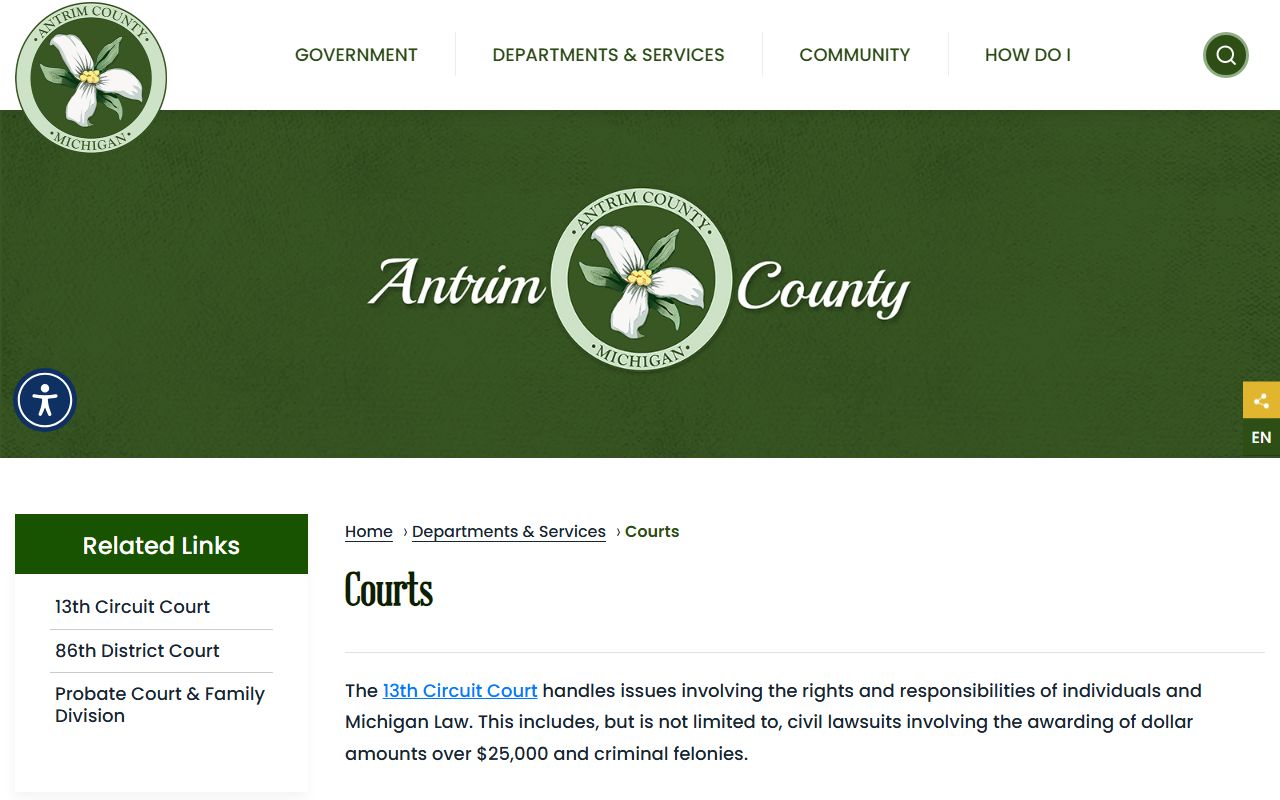
The screenshot reinforces the local division of labor: District Court is often the first criminal/traffic court contact after arrest, while Circuit Court becomes central for felony proceedings and appeals.
- Collect the person's full legal name, date of birth if known, arrest date, and any incident report or case number.
- Call the jail at 231-533-8627 if the person may still be in custody, and ask which court has the next appearance or bond order.
- Use the 86th District Court cases endpoint for misdemeanor, traffic/criminal, first-appearance, and preliminary-examination stage records.
- Use the 13th Circuit criminal-records endpoint for felony cases, bindovers, circuit-level criminal proceedings, and later felony dispositions.
- Search MiCOURT Case Search when a local endpoint is unavailable or when a statewide participating-court search is more useful.
- Contact the court clerk if an online portal does not show the case. Older files, suppressed records, juvenile matters, sealed records, and document-level access may require direct court contact.
Michigan State Police ICHAT is another statewide channel, but it is not a warrant search or a live jail roster. MSP describes ICHAT as public criminal history record information maintained by the Criminal Justice Information Center, including felonies and serious misdemeanors required to be reported by agencies, prosecutors, and courts. Suppressed records and warrant information are not available through ICHAT.
How Court Charges Get Filed After an Arrest
Booking happens first. A sheriff's deputy, local police officer, Michigan State Police trooper, or another authorized officer arrests the person and transports them to the Antrim County Correctional Facility. Jail staff identify the person, connect the intake to an agency report or warrant, create the custody file, and handle booking steps. The prosecutor then decides what criminal charges, if any, should be filed in court. That is why court records after a jail arrest may not match the words used at intake.
| Document | Who Files or Issues It | How It Fits an Antrim Case |
|---|---|---|
| Complaint | Usually the prosecutor, based on law-enforcement reports | Common document used to begin many Michigan criminal cases after an arrest. |
| Information | Prosecutor | Felony charging document used in circuit court after preliminary-exam bindover or waiver. |
| Indictment | Grand jury | Possible in Michigan criminal law, but not the routine path for every local arrest. |
The Prosecuting Attorney appears for the People of the State of Michigan in adult criminal prosecution in the 86th District Court and 13th Circuit Court. The office may also appear in Family Court Division matters involving juvenile delinquency and abuse or neglect, but public access to juvenile records is more restricted than adult criminal dockets.
Charge Status in Court Records After Arrest
Charges can change as an Antrim County case moves from arrest to arraignment, preliminary examination, bindover, plea, trial, or dismissal. A booking allegation may be amended after prosecutor review. A felony count may be bound over to Circuit Court. A misdemeanor may resolve in District Court. A dismissed count may remain visible as a docket event even though it is not a conviction.
| Status | What It Means |
|---|---|
| Pending | The case or count has not reached final disposition. |
| Amended | The originally filed charge was changed after filing. |
| Reduced | The offense level or charged offense was lowered, often as part of plea or review. |
| Dismissed | The court or prosecutor ended that count or case without a conviction on that count. |
| Bound over | A felony moved from District Court proceedings to the 13th Circuit Court. |
| Disposition | The current or final outcome, such as plea, trial verdict, sentencing, dismissal, or closure. |
Bond and Release After an Arrest
Bond information can sit in both the jail and court workflows. The jail can often tell a caller whether the person is in custody and whether a releasable bond appears in the current file. The 86th District Court is important because the county court materials say its Criminal/Traffic division receives and disburses bonds and communicates with the jail regarding sentencing inmates. If a felony has moved to the 13th Circuit Court, confirm current bond procedures through the circuit-court channel as well.
| Bond Type | How It Works |
|---|---|
| Personal recognizance / PR | Release based on a promise to appear, usually with court conditions and no upfront cash. |
| Cash bond | Money must be paid before release. Verify whether the court requires full cash, 10%, or another local instruction. |
| Surety bond | A surety may guarantee payment if the court allows it for that case. |
| Conditional release | Release with terms such as no contact, testing, alcohol/drug limits, GPS, or other court conditions. |
| No-bond hold | The person cannot be released by simply posting a standard amount. |
| Hold for another agency | A separate county, parole/probation, federal, or ICE hold can block release even after local bond is posted. |
No official Antrim County bond-payment fee table or full accepted-payment list was located in the research. Before paying, verify the amount, payment method, location, case number, and whether any detainer prevents release.
Warrants That Lead to an Arrest
No official Antrim County active warrant search or warrant list was found on the Sheriff's Office, jail, court, or county online services pages. A warrant can still be the reason for booking. Arrest warrants, bench warrants, probation or parole holds, fugitive holds, and out-of-county detainers may all produce an Antrim County jail record after law enforcement takes the person into custody.
The fallback chain is direct: call the Sheriff's Office or jail at 231-533-8627 for current custody, search the 86th District Court or 13th Circuit Court record if a case number is known, use MiCOURT for participating-court records, and contact the court clerk when the record is not online. FOIA may help with existing non-exempt sheriff records, but active investigative details, institutional-security information, juvenile records, and certain personal information may be withheld under Michigan law.
Charges vs. Convictions
An arrest and a charge are not the same as a conviction. A booking photo or jail record only shows that a person was taken into custody. A complaint only shows that the prosecutor filed an accusation. A conviction requires a guilty plea, verdict, or other legal finding entered by the court.
| Charge | Conviction | |
|---|---|---|
| Stage | Accusation filed in court | Final legal finding or plea |
| Standard | Based on probable cause and prosecutor filing decisions | Based on proof beyond a reasonable doubt or a valid plea |
| Record Meaning | Shows the case was filed, not that the person was guilty | Shows the person was legally convicted of that offense |
| Where to Check | District/Circuit docket, complaint, case events | Disposition, judgment, sentencing, MSP/ICHAT where reportable |
Sealed vs. Expunged Arrest Records
Michigan uses record-restriction and set-aside rules that affect public visibility, but the exact result depends on the case, charge, disposition, and agency system. MCL 764.26a addresses certain arrest-record restriction outcomes, including no-charge or dismissal contexts. MCL 780.621g addresses automatic set-aside rules for eligible misdemeanor convictions. These laws can affect criminal-history visibility, but they do not create a blanket promise that every jail, court, or third-party copy disappears automatically.
| Restricted / Sealed | Set Aside / Expungement | |
|---|---|---|
| Public visibility | Hidden or limited from ordinary public access in qualifying circumstances. | Conviction treated under Michigan set-aside law if eligible and processed. |
| Agency access | Law-enforcement or court access may remain for permitted purposes. | Some government access may remain under Michigan law. |
| Antrim action point | Confirm the court disposition and ask the record-holding agency how restriction is reflected. | Check court orders, MSP/ICHAT status, and agency records rather than assuming removal. |
Background Check Considerations
Public court lookup is different from an employment, housing, credit, insurance, or tenant-screening background check. A docket can show pending charges, dismissed counts, amended charges, and case events that require context. Anyone using criminal-history information for a regulated decision needs a lawful, FCRA-compliant source and process.
Important: This website is not a consumer reporting agency and cannot be used for FCRA-covered decisions.
Restricted Court Records After an Arrest in Antrim County
Michigan FOIA begins with a public-access policy in MCL 15.231, but access is not unlimited. MCL 15.243 allows exemptions for several categories, including certain law-enforcement investigative records, personal privacy, and information that would prejudice the security of a custodial or penal institution unless the public interest outweighs nondisclosure. Juvenile matters, sealed files, suppressed records, medical details, victim-protection information, and active investigations may not appear in ordinary public search results.
The same practical rule applies across the Antrim court and jail systems: verify the record with the office that created it. Use the court portals for the filed case, the jail or Sheriff's Office for custody status, the Antrim County FOIA request page for county records, and the Sheriff's FOIA PDF when a sheriff report, booking file, incident number, or jail record is needed.